|
|
|

Remington, Russell and the Language of
Western Art at The Bowers Museum of
Cultural Art, July 7-September 16, 2001
John James Audubon in the West: The
Last Expedition, Mammals of North
America at the Autry Museum of
Western Heritage, June 24-September
30, 2001
The Great Wide Open: Panoramic
Photographs and Western Spaces at
The Huntington Library, Art Collections
and Botanical Gardens, June
14-September 16, 2001
Incarcerated: California in the 21st
Century at the Santa Barbara
Contemporary Arts Forum, July
7-August 19, 2001
How the West Was Shown
By Beth Kracklauer
Wide-open vistas dotted with saguaro and
buffalo skulls. A Cheyenne scout galloping
his pony across a dusty plain. A
buckskin-clad cowboy casting out his lasso.
These scenes of the Old West are so deeply
ingrained in our collective unconscious, it's
as if we've actually seen them for ourselves.
Of course, these images come down to us in
the same way so many of our primal images
do: filtered through the eyes and
imaginations of artists. Four exhibitions on
view this season consider varying visions of
the American West—and their profound
impact on the landscape as we know it
today.
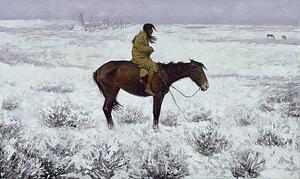
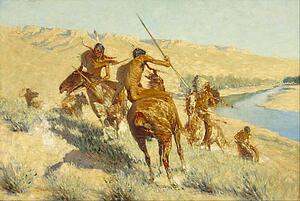
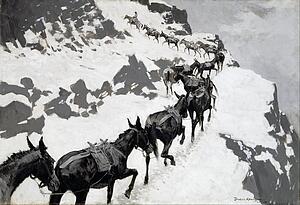
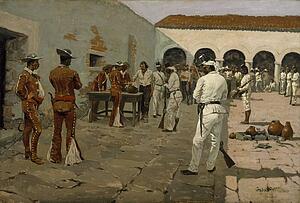
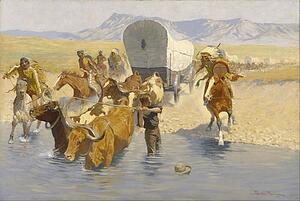
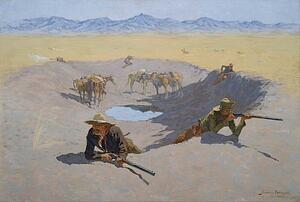
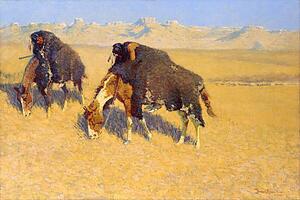
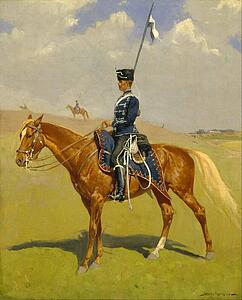
Mention art of the American West, and two names will inevitably come up, often in the
same breath: Frederic Remington and Charles M. Russell. Remington, Russell and
the Language of Western Art, on view at The Bowers Museum of Cultural Art July
7-September 16, compares their paintings, bronzes, and illustrations—and their
versions of the West based equally in experience and reverie.
Showdown
Like Remington (1861-1909), who spent a year on a sheep ranch before trading in his
lasso for a paintbrush, Russell (1864-1926) tried out the cowboy life—riding cattle for
more than a decade—before turning to art as a career. And while Remington's works
tended to grow out of abstract concepts—"man's triumph over nature," say—Russell's
more often recalled specific incidents in scrupulous detail. In Russell's Roping a Grizzly
(1903), three men on horseback subdue a rampant bear with their nimble lassos. This
artist, clearly, was a man who knew his way around a rope—although the scene is as
likely to have come from a book as from Russell's own life.
By the end of their careers, both artists lamented the fencing-in of the lands the
cowboys had once roamed and the total subjugation of the Indian population—results of
the westward expansion that their art had, however unwittingly, stimulated. One of
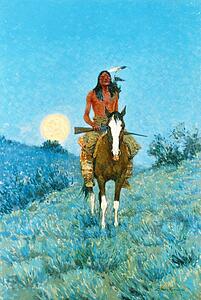
Remington's final paintings, When His Heart Is Bad (1908), powerfully evokes this
aching nostalgia for a time when man lived in harmony with his environment. Its lone
Indian meditates on a hilltop in the deepening twilight, the colors of his attire blending
almost seamlessly with the grass and sky around him.
Down to a Science
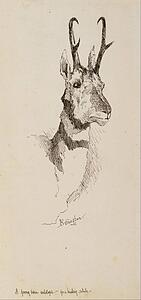
For an "accurate" depiction of the West, perhaps we should look to a more scientific
record—precisely the goal of renowned naturalist John James Audubon's 1843
expedition up the Missouri River. On view at the Autry Museum of Western Heritage
June 24-September 30, John James Audubon in the West: The Last Expedition,
Mammals of North America retraces this expedition in Audubon's original oils and
prints, alongside art of his contemporaries, original letters, and artifacts collected along
the journey.
This final expedition was a challenging
one for the aging Audubon, but one he
insisted on taking, with equal parts
scientific rigor and bravado. His work
displays a similar combination:
meticulous observation processed
through a decidedly romantic sensibility.
Images of such near-extinct species as
the black-footed ferret represent not only
a natural world all but lost to us, but an
explorative spirit that led thousands
westward in the late 19th century.
Another powerful westward draw during those years was the burgeoning medium of
photography—particularly the wide-angle views of the Western landscape so popular at
the time. The Great Wide Open: Panoramic Photographs and Western Spaces, on
view at The Huntington Library, Art Collections and Botanical Gardens June
14-September 16, presents some 75 of these photographs dating from the 1840s to
the present. These expansive images amplified the sense of the American West as a
land of limitless space and resources—Manifest Destiny writ large.
Don't Fence Me In
Untapped resources. Boundless freedom. And a seductive hint of lawlessness and
danger. That's the vision of the West left behind by artists of the 19th century. Now, at
the beginning of the 21st century, L.A. artist Sandow Birk is examining the lingering
residue of this vision in his home state—once promoted as a paradise of opportunity
for all, from homesteaders to gold prospectors to aspiring matinee idols.
Today California has a higher percentage of its population in prison than any other
place in the world. Incarcerated: California in the 21st Century, on view at the
Santa Barbara Contemporary Arts Forum July 7-August 19, features a new series
of paintings and prints recording Birk's own expeditions into unfamiliar territory:
California's 35 state and federal prisons. Rendered in the style of such 19th-century
landscape painters as Thomas Cole and Albert Bierstadt, these images present a wry
view behind the bars constructed to contain the very lawless elements once so
prized—in the abstract. Depicting some of the grittiest scenes imaginable in an
ultra-romantic 19th-century style, it's a penetrating look at some of our most cherished
national myths—and their harsher contemporary flip side.
MUSEUMS LOS ANGELES • SPRING 2001
Key Terms:
Frederic Remington
Charles M. Russell
saguaros
buffalo skulls
Cheyenne
cowboys
lassos
Western
cattle
grizzly bears
First Nations
John James Audubon
19th Century
Photography
Ansel Adams Landscapes
Los Angeles
California
prisons
Thomas Cole
Albert Bierstadt
See Also:
Landscape Photography
Landscape
Photography
Imprisonment
back to the Museumgoer Index
|